Gate
A gate that knows your track
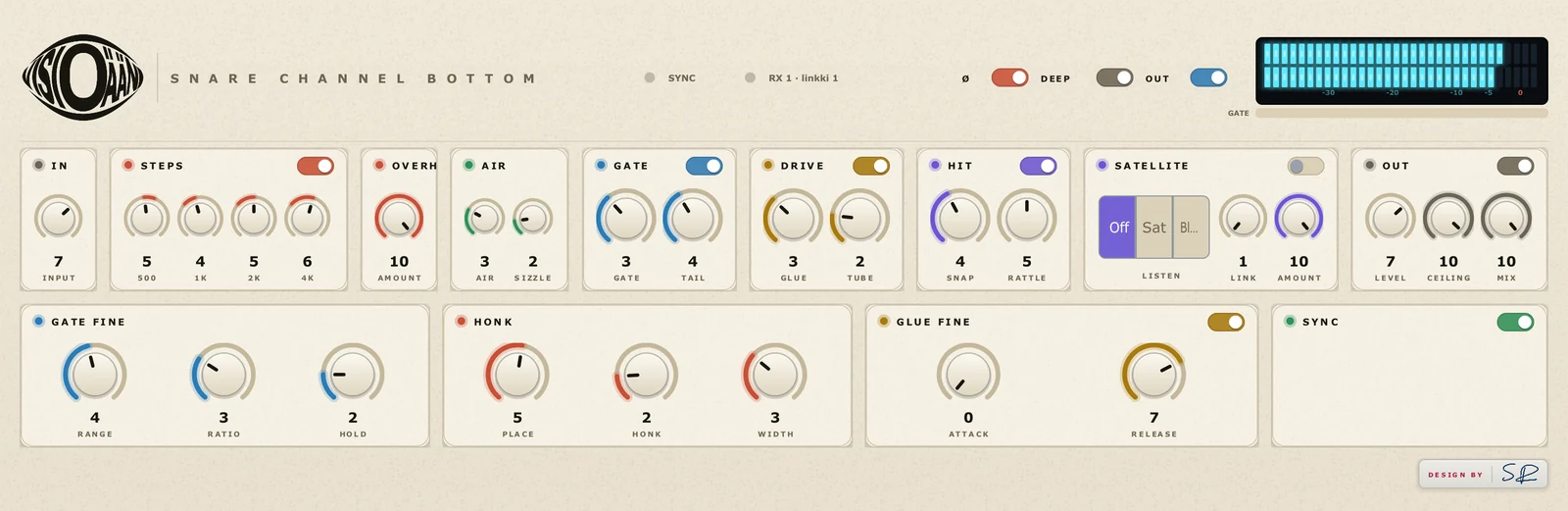
The threshold follows the track's own peak, so Gate 3 means the same distance below the hardest hit on every track. It sits after the compressor and removes exactly what the compressor lifted.
Snare bottom channel · VST3 · AU
The half of the snare most mixes forget. It arrives polarity-flipped and high-passed, because the bottom mic sits on the other side of the head. Cut runs 60–600 Hz; the default 140 Hz keeps the drum's body and takes the rumble out.
Air and Sizzle bring the wires forward, Glue holds them there, the gate keeps the spill out and Tube warms the whole thing with even harmonics.
Gate
The threshold follows the track's own peak, so Gate 3 means the same distance below the hardest hit on every track. It sits after the compressor and removes exactly what the compressor lifted.
Overhead
The Overhead module carries the tone of the overhead channel: 528 Hz high-pass, the Arizona clank cut and an API 2500-style glue. Amount 0 is the plain bottom mic.
Sizzle
Sizzle adds harmonics on 3–9 kHz, where the wires live. Air is a 12 kHz shelf with a deliberately wide range.
Sync
The bottom mic lines up with the top mic on the 80–400 Hz band. Its polarity is never flipped automatically, because the flip is intentional.
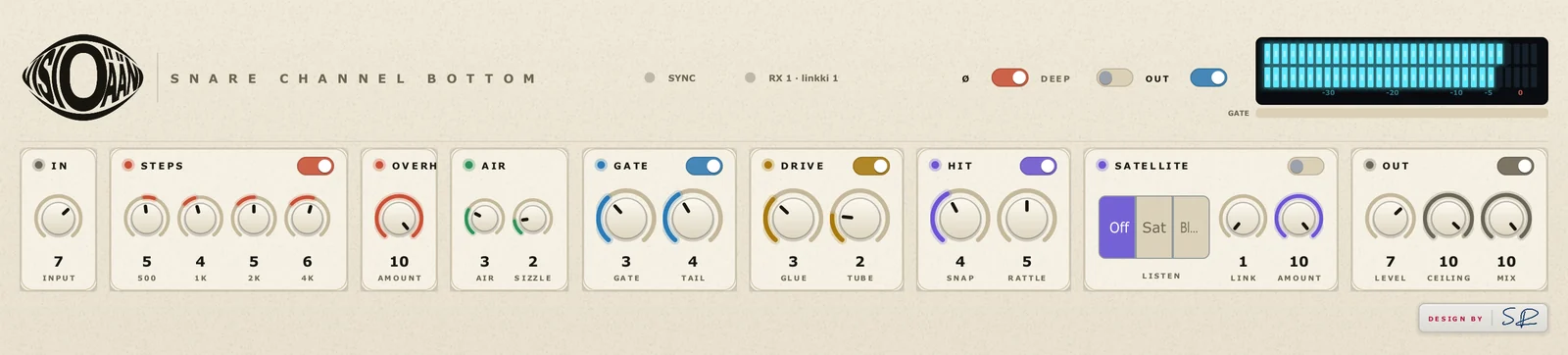
The front panel, left to right and top to bottom. Every control reads 0–10. DEEP adds: Gate Fine (Range, Ratio, Hold), Honk (Place, Honk, Width), Glue Fine (Attack, Release), Sync.
| Module | Controls | What it does |
|---|---|---|
| In | Input · Cut | Input trim and the high-pass, 60–600 Hz, default 140 Hz. The polarity flip is fixed. |
| Steps | 500 · 1K · 2K · 4K | Four fixed tone steps, amount only. |
| Overhead | Amount | Overhead-style tone and glue, 0–100 %. |
| Air | Air · Sizzle | 12 kHz shelf and harmonics for the wires. |
| Gate | Gate · Tail | Level-aware downward expander after the compressor. |
| Drive | Glue · Tube | API 2500-style compressor and asymmetric tube drive. |
| Hit | Snap · Rattle | Transient shaper with its own timing for the wires. |
| Satellite | Listen · Link · Amount | Removes hi-hat bleed using the Hihat + Cymbal plugin as the reference. |
| Out | Level · Ceiling · Mix | Look-ahead limiter and dry/wet. |
Bottom snare close mic, defaults only, share of energy per band.
| Band | Raw | Defaults |
|---|---|---|
| Body 120–250 Hz | 25.6 % | 0.0 % |
| Cardboard 250–600 Hz | 10.6 % | 0.3 % |
| Crack 1.5–4 kHz | 10.3 % | 23.7 % |
| Wires 4–8 kHz | 25.3 % | 61.9 % |
| Quietest 100 ms (bleed) | −52.5 dBFS | −48.5 dBFS |
Visioääni started about two years ago from a habit we wanted to break. Every drum mix ended up with a stack of different plugins on every mic: one for the gate, one for the EQ, one for the transients, one for the compression, and something else again for the bleed and the phase. It worked, but it was slow, and every session started from the same pile.
So we asked whether one set could do all of it, and do it quickly. The answer became seven channels, one for each drum mic, that find each other inside the DAW. The defaults were measured on real sessions before they were set, and the controls were cut down to the few a drum actually needs, each from 0 to 10.
Snare Bottom went through the beta with testers in nine countries. It got 5 changes in the beta releases from 1.1 (28 September 2026) to 1.4.9 (12 November 2026), 1 of them from testers' reports. The list comes from the release notes, newest first. The beta continues.
Changes shared by all seven plugins, such as the resizable window, the tooltips and bypass that keeps the timing, are in the release notes.
No. The bottom plugin flips it for you, and Sync never flips it back.
Cut is the high-pass on the bottom mic, 60–600 Hz. The top mic carries the body, so the old fixed cut sat at 528 Hz and kept only the wires. Since 1.4.2 the default is 140 Hz: the drum's body comes through the bottom mic too, and the hiss between hits sits at the dry track's level. Raise it toward 500 Hz if you want the wires only.
Lower Gate. The threshold is relative to the track's hardest hit, so one setting behaves the same on every song.
Visioääni is a team of three in Tampere, Finland. The project started about two years ago, from mixing real drums with a different plugin for every job on every mic and asking whether one set could do it all, quickly. Snare Bottom got 5 changes in the beta releases 1.1 to 1.4.9, 1 of them from testers' reports. They are listed on this page under How it was made.
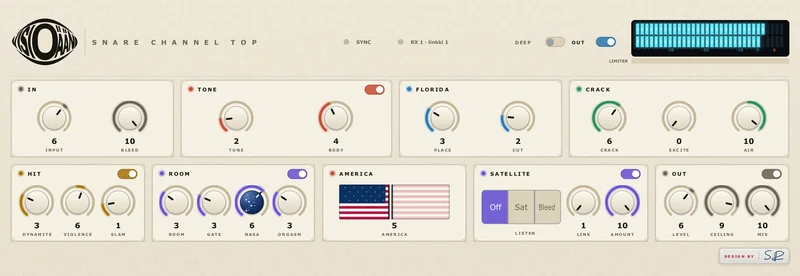
Florida removes the cardboard without dropping your level. Tune builds the body at the drum's own note, Crack and Air put the top on, and a chamber sits behind it.
Florida shaper · chamber Details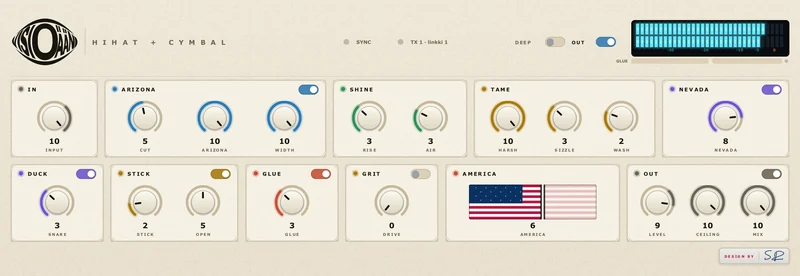
Shimmer without the shards. Nevada pulls down the narrow resonances that make a cheaper cymbal shrill, and Satellite lets the other mics remove the hi-hat.
Nevada · Satellite Details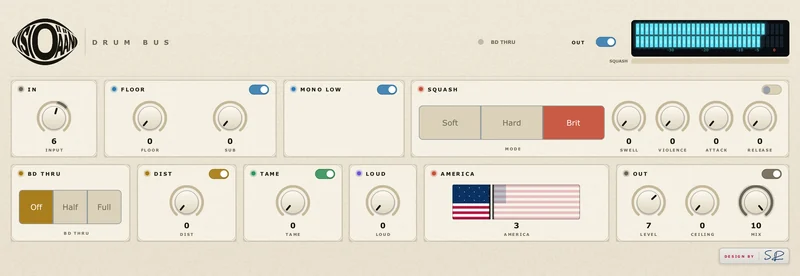
Glue that leaves the sub alone. Floor at 30 Hz, Soft, Hard or Brit squash, Tame for the 4 kHz pile-up, Loud for level without the squash, and Mono Low.
No-pump glue · Loud DetailsOne email before the pre-sale ends on 30 November, with gain-matched before-and-after examples. Nothing else, and you can leave the list at any time.