Squash
Compression above 80 Hz
A Linkwitz-Riley split at 80 Hz. With Sub at 0 the low band passes untouched: its crest factor stayed at 19.4 dB while the 80–250 Hz band tightened from 20.3 to 18.9 dB. Soft, Hard and Brit set the knee and speed.
Drum bus · VST3 · AU
The last plugin on the drum group. The compressor only hears what is above 80 Hz, so the kick's sub never pumps the kit, and Sub decides how much of it gets squashed at all.
Tame takes care of the pile-up at 4 kHz that every bright channel adds, Loud raises the level without moving the peaks, and Mono Low centers everything under 120 Hz.
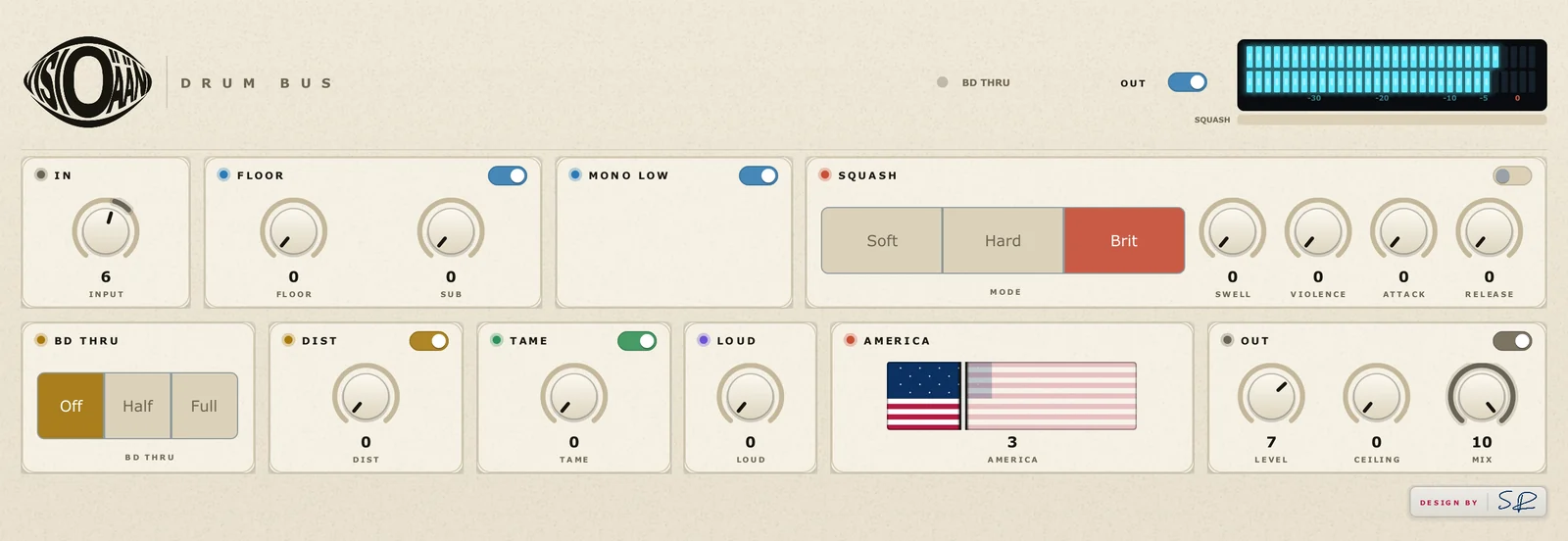
Squash
A Linkwitz-Riley split at 80 Hz. With Sub at 0 the low band passes untouched: its crest factor stayed at 19.4 dB while the 80–250 Hz band tightened from 20.3 to 18.9 dB. Soft, Hard and Brit set the knee and speed.
Tame
Each channel brightens its own drum, and on the bus the 4 kHz area adds up. Tame took the bus from −12.1 to −14.7 dB at 4 kHz; recent American rock and metal records measured −17 to −18.
Loud
Three band limiters cut each band's own peaks and give the same amount back. At Loud 10 the peak stayed put, RMS rose 2.3 dB and the tone moved less than ±1.5 dB.
Mono Low
Everything under 120 Hz goes mono: side over mid at 20–120 Hz went from −12.9 to −25.1 dB, while the width of toms and overheads above 300 Hz stays as it was.
The front panel, left to right and top to bottom. Every control reads 0–10.
| Module | Controls | What it does |
|---|---|---|
| In | Input | Input trim. |
| Floor | Floor | High-pass at 30 Hz by default, fourth order. |
| Mono Low | Mono Low | Everything under 120 Hz to mono. |
| Squash | Swell · Violence · Sub · Mode | Bus compression above 80 Hz, Soft, Hard or Brit. |
| BD Thru | Off · Half · Full | Lets the kick's feed from the Kick plugin past the compressor. |
| Dist | Dist | Second and third harmonics, oversampled, level-matched. |
| Tame | Tame | Static and dynamic control of the 4 kHz pile-up. |
| Loud | Loud | Three-band peak limiting with the gain given back. |
| America | America | The last tonal stage. |
| Out | Level · Ceiling · Mix | Final limiter and dry/wet without phasing. |
Loud on a full kit, everything else fixed.
| Loud | Peak | RMS | Crest factor |
|---|---|---|---|
| 0 | −12.78 dBFS | −29.57 dBFS | 16.8 dB |
| 4 (default) | −12.78 dBFS | −28.88 dBFS | 16.1 dB |
| 6 | −12.78 dBFS | −28.17 dBFS | 15.4 dB |
| 10 | −12.66 dBFS | −27.29 dBFS | 14.6 dB |
Visioääni started about two years ago from a habit we wanted to break. Every drum mix ended up with a stack of different plugins on every mic: one for the gate, one for the EQ, one for the transients, one for the compression, and something else again for the bleed and the phase. It worked, but it was slow, and every session started from the same pile.
So we asked whether one set could do all of it, and do it quickly. The answer became seven channels, one for each drum mic, that find each other inside the DAW. The defaults were measured on real sessions before they were set, and the controls were cut down to the few a drum actually needs, each from 0 to 10.
Drum Bus went through the beta with testers in nine countries. It got 5 changes in the beta releases from 1.1 (28 September 2026) to 1.4.9 (12 November 2026), 2 of them from testers' reports. The list comes from the release notes, newest first. The beta continues.
Changes shared by all seven plugins, such as the resizable window, the tooltips and bypass that keeps the timing, are in the release notes.
No. The dry path is delayed to match the processing, and the measured difference between Mix 50 % and 100 % with the modules off is −47.8 dB.
The Kick plugin can feed its signal to the bus. BD Thru decides how much of that feed bypasses the bus compressor, so the kick keeps its punch while the rest of the kit is glued.
Visioääni is a team of three in Tampere, Finland. The project started about two years ago, from mixing real drums with a different plugin for every job on every mic and asking whether one set could do it all, quickly. Drum Bus got 5 changes in the beta releases 1.1 to 1.4.9, 2 of them from testers' reports. They are listed on this page under How it was made.
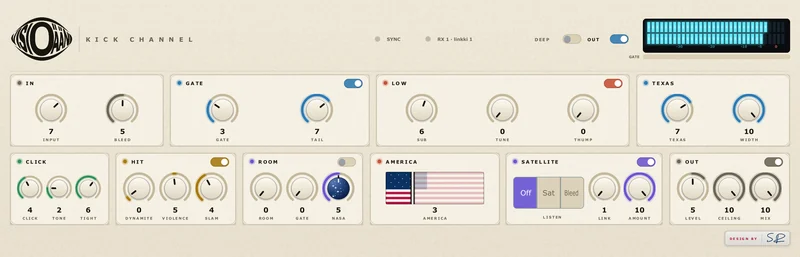
Texas-size cut from the muddy area, a beater click built from your own kick, sub that hits and a room that leaves the low end dry.
Texas cut · real click Details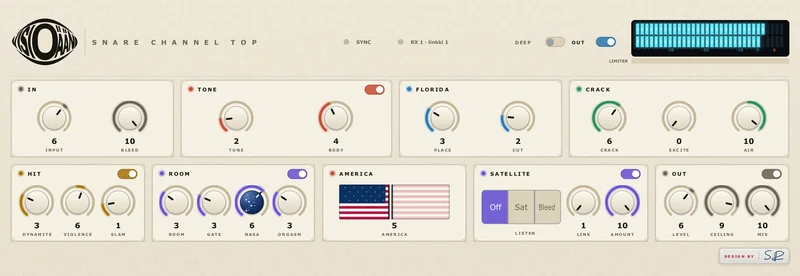
Florida removes the cardboard without dropping your level. Tune builds the body at the drum's own note, Crack and Air put the top on, and a chamber sits behind it.
Florida shaper · chamber Details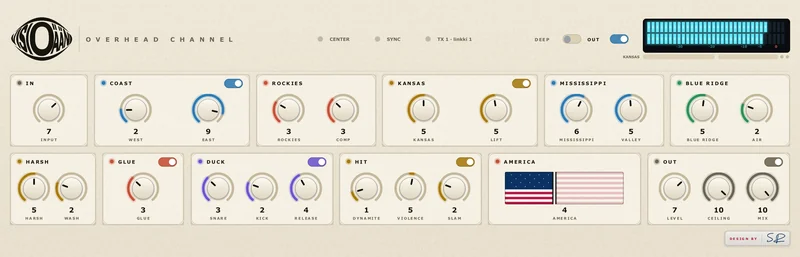
The whole kit as one picture with the cymbals tamed: a west-to-east EQ map, Kansas compression in the middle and a Duck that hears the snare and kick. One switch turns the same panel into the room channel, with Slam as the smash.
Coast to coast. Then the room. DetailsOne email before the pre-sale ends on 30 November, with gain-matched before-and-after examples. Nothing else, and you can leave the list at any time.