How to remove the cardboard sound from a snare
Short answer. The cardboard sound in a close snare mic is a narrow resonance at about 1.5 times the drum's fundamental, usually 300–340 Hz on a snare tuned to 200–215 Hz. Cut it with a narrow, steep notch at that exact frequency, give back the low end the cut takes from the fundamental, and match the level before you judge the result.
Find the fundamental first
Every snare has a strong fundamental. In four snares from four projects, three sat at 202 Hz and one at 214 Hz. Find yours with a narrow boost swept slowly through 150–250 Hz: the fundamental is the point where the drum suddenly gets bigger.
The cardboard sits at about 1.5 times the fundamental
On the same four drums the boxy resonance was at 302 Hz (three drums) and 339 Hz (one drum). That ratio is consistent enough to start from: multiply the fundamental by 1.5 and sweep a narrow cut around that point.
Use a narrow notch, and place it exactly
The resonance is narrow, about 45 Hz wide (Q 6–9). A notch that misses by 10 Hz loses 2 dB of its attenuation, and a 26 Hz miss loses 6 dB. Wide cuts reach down into the fundamental and thin the drum out.
| Frequency | Wide hand-made cut | Steep notch with low-end give-back |
|---|---|---|
| 100 Hz | −3.9 dB | +1.3 dB |
| 214 Hz (fundamental) | −8.3 dB | −1.4 dB |
| 339 Hz (cardboard) | −8.7 dB | −13.8 dB |
| 700 Hz | −5.8 dB | −7.6 dB |
Give the fundamental back
Any cut leaks downward. Measure what the cut takes at the fundamental and return it with a low shelf. The drum keeps its body and loses only the box.
Match the level before you listen
A cut makes the drum quieter, and quieter usually sounds worse. Without compensation the RMS level fell 2.3 dB when the cut reached 24 dB. With level matching measured while the audio runs, it stayed within 0.43 dB over the whole range while the boxy share of the energy dropped from 21.4 % to 2.5 %.
In Visioääni Snare
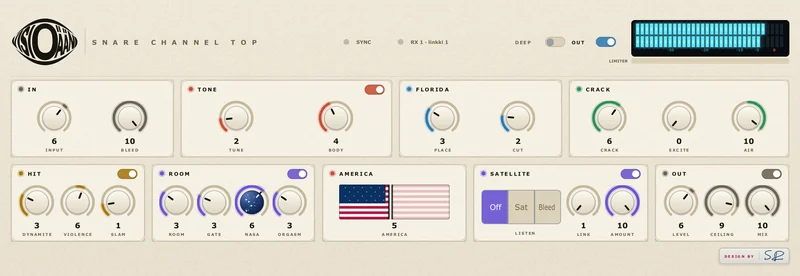
Set Tune to the fundamental and Place to the cardboard. Cut sets the depth. Florida's low side is a near-vertical wall (−89.8 dB per octave) and its high side a gentle coast, the give-back shelf is automatic, and the level match runs all the time.