How to tame harsh cymbals and hi-hats
Short answer. Cymbal harshness is usually a handful of narrow resonant peaks between about 3 and 14 kHz that ring on some hits, not the whole top end. Turn those peaks down only while they ring, with a dynamic resonance suppressor or a dynamic EQ, instead of a wide static cut that dulls every hit. Keep the movement slow enough not to sound like a phaser, check that nothing before the EQ is clipping, and check the drum bus, where close mics that each lift 3-5 kHz stack up.
A few peaks, not the whole top end
Buhr Audio puts it plainly: Harshness in the top end is almost never the whole high frequency range — it's a handful of narrow, resonant peaks that spike on certain hits and make your ears flinch.
Sizzle sits at roughly 6-12 kHz and metallic ring lower. Henrik Udd cuts a nasty peak around 4.2kHz
, a whistling tone, from the cymbals with a narrow Q, and Mike Senior took the edge off a hi-hat in a Sound On Sound Mix Rescue with narrow 5 dB and 2.5 dB dips at 14 kHz.
Cheaper cymbals make it worse. B8 bronze has a simpler overtone structure with a pronounced midrange, while B20 builds a dense acoustic fabric
of overtones, so the few strong peaks of a cheap cymbal stand out more.
Turn them down only while they ring
A static cut wide enough to catch the peaks also takes the sparkle from every quiet hit. A dynamic suppressor finds the peaks as they ring and lowers only those. Two details decide whether it works:
- Compare each band with both neighbours. A band is a resonance only if it rises above the bands on both sides (about a third of an octave away). Our first version compared it with a symmetric average and mistook the natural treble roll-off for a resonance.
- Resonances ring, noise does not. Smoothing the detection over 60 ms lets the stick attack through. Reacting to single frames dimmed the start of each hit by 3.7 dB on average.
A real-valued gain does not rotate the phase (cross-correlation peak at 0 samples with the suppressor on and off), so the cymbals stay in phase with the snare and the overheads.
Measured
Worst peak above a 1/6-octave smoothed curve, before and after the suppressor at 80 %:
| Material | Before | After |
|---|---|---|
| Crash close mic, demo recording | 13.4 dB | 8.1 dB |
| Second crash take | 10.2 dB | 7.8 dB |
| Cymbals from an old sample CD | 12.1 dB | 8.6 dB |
On a synthetic cheap cymbal with nine known resonances the peaks dropped 7.7 dB on average and 12.8 dB at most (3.17 kHz). A good cymbal with the same wash and no resonances moved less than 0.1 dB, and the first 10 ms of each hit lost only 0.3-0.7 dB.
Too much movement sounds like a phaser
A beta tester heard our first defaults on an open hi-hat as a phaser. The notches moved with every hit. We measured the movement of the spectral shape over time with the broadband gain removed: 2.51 dB. Slower release times and a smaller amount brought it to 1.02 dB. On a crash, the movement rose with the amount: 1.13 dB at 0 %, 1.39 at 20 %, 1.53 at 35 % and 1.71 at 50 %. If the cymbals start to swirl, lower the amount or slow the release before you blame the cymbal.
Check the gain and the drum bus
Harsh is not always EQ. With our own early defaults, 18.6 dB of gain in the chain pushed a close hi-hat into the ceiling: the crest factor fell from 19.5 to 13.9 dB, and that squashed top end read as harsh. Take the gain out first.
Then look at the bus. Each close mic gets its own 3-5 kHz lift for good reasons, but on the drum bus they add up. Our bus sat 5-7 dB above three recent American rock and metal records at 4 kHz (third-octave averages over 60 s). A wide static bell at 4 kHz plus a dynamic cut on the hardest hits brought it from -12.1 to -14.7 dB, against -17.4 to -20.0 dB on the records.
What EQ cannot do
A suppressor lowers peaks. It does not add the complex overtones a cheap cymbal lacks, so a brittle cymbal becomes smoother, not expensive.
In Visioääni
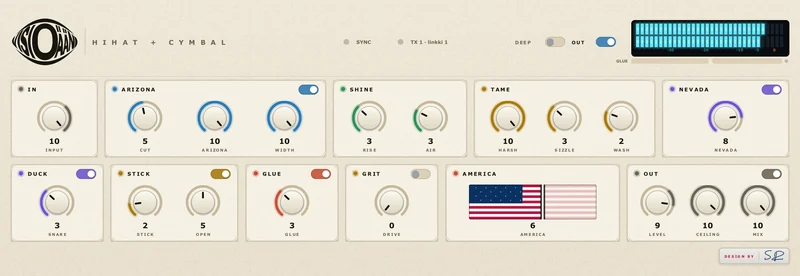
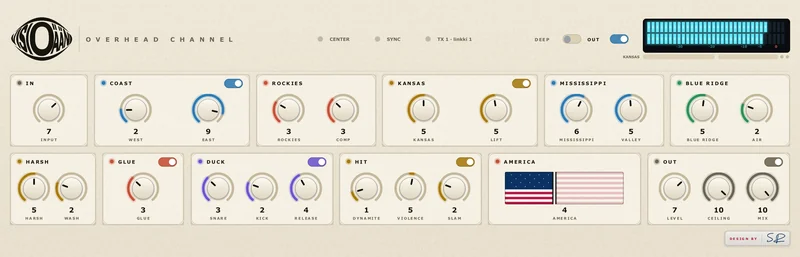
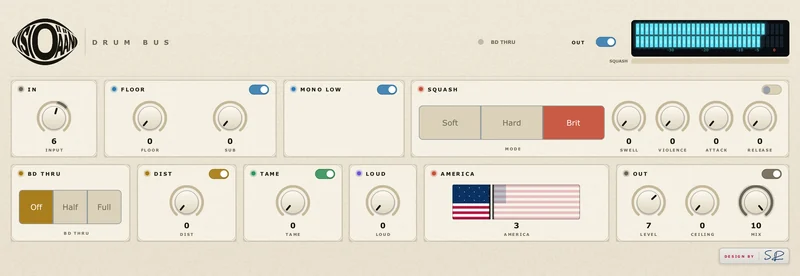
Hihat + Cymbal: Nevada is the resonance suppressor (one knob, default 30 %, a compromise between the bite and the phaser), Harsh cuts 3-5 kHz on hard hits only, Sizzle de-esses 10-12 kHz and Cut is the high-pass (default 300 Hz). Overhead/Room: a fixed narrow cut at 2.4 kHz (Mississippi), Harsh as a dynamic cut at 3.5 kHz and Wash as a slow dynamic cut at 8 kHz for crash and blast-beat wash. Drum Bus: Tame is the 4 kHz bell plus dynamic cut for the pile-up.
Sources: Buhr Audio, Nail The Mix (Henrik Udd), Sound On Sound Mix Rescue, Cymballand (B8 vs B20).