Why a drum bus compressor pumps, and how to stop it
Short answer. A drum bus pumps when the kick's low end drives the compressor, so every kick hit turns the whole kit down. Keep the detector above about 80 Hz and leave the band below it uncompressed, or take the kick past the compressor. If you blend in the dry signal, send it through the same crossover phase as the compressed path, or the blend cancels at the crossover frequencies.
Why it pumps
A compressor turns the whole signal down by the amount its detector asks for. On a drum bus the strongest thing the detector hears is the kick's low end, so each kick hit pulls the snare, the toms and the cymbal tails down with it, and they swell back up between the hits. That breathing is the pump.
Keep the compressor above 80 Hz
Many bus compressors have a sidechain high-pass for exactly this reason: the detector stops reacting to the kick's sub. One step further is to split the bus at 80 Hz and compress only the upper band. Measured as crest factor per band on a full multitrack kit:
| 20-80 Hz | 80-250 Hz | |
|---|---|---|
| Before the bus | 18.9 dB | 20.3 dB |
| Upper band compressed, sub untouched | 19.4 dB | 18.9 dB |
| Sub compressed too | 17.9 dB | 18.2 dB |
With the sub left alone the kick keeps its punch, and the body of the kit above 80 Hz still gets the glue.
Take the kick past the compressor
The old way is to send the kick straight to the mix and skip the drum bus. If the kick has to stay on the bus, subtract it before the compressor and add it back after. That needs a sample-accurate delay and a matched gain: a subtraction that is off in time adds a delayed copy of the kick instead of removing it.
In a test with known offsets, cross-correlation found the delay exactly (700 samples late and 300 samples early), and the subtraction took 5-13 dB of kick out of the bus's low band. It does not go deeper because the snare also lives in that band and cannot be subtracted. Run the subtraction only while it measurably helps: Visioääni switches it on when the low-band residual falls below -2 dB and off again above -0.7 dB.
Blending in the dry signal: match the crossover phase
If the compressed path goes through crossovers (a split at 80 Hz, a multiband limiter), its sum is flat in level, but its phase turns a full circle around each crossover. At the crossover frequency the wet signal is out of phase with the dry one, so a 50/50 blend cancels there. With every module off, a 50 % blend should equal the input. On our bus, with crossovers at 80 Hz, 150 Hz and 3 kHz, the difference was only 21 dB below the signal, enough to hollow out a kick tuned near 130 Hz.
The fix is to send the dry signal through the same crossovers without processing, so both paths turn together. Matching the exact topology, including the DC blocker, brought the difference down to -47.8 dB.
Judge at the same loudness, on the right band
Compression and saturation make the bus louder, and louder sounds better, so match the level before you compare. Match it on the band the compressor works on. When our level match measured the full band, heavy compression left 500-2000 Hz 11 dB below the input while the meter read equal: the untouched sub filled the reading. Match on the band above 80 Hz, the band the compressor actually changes, and the comparison is fair.
In Visioääni Drum Bus
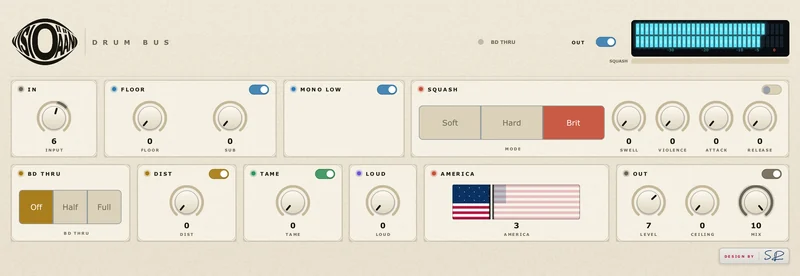
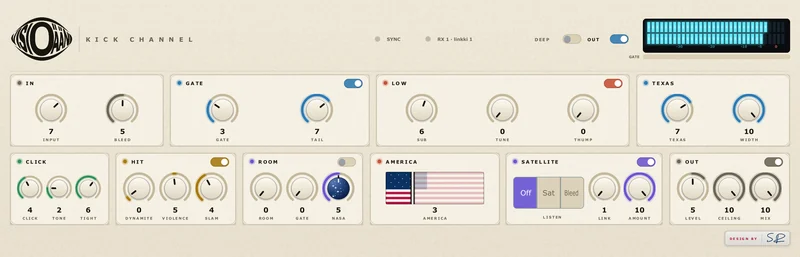
The bus is split at 80 Hz with a Linkwitz-Riley crossover. Squash hears only the upper band, and Sub sets how much of the gain reduction reaches the band below; at 0, the default, the sub passes untouched. BD Thru (Off, Half, Full) reads the Kick plugin's output inside the host, measures the delay and the gain, removes the kick before the compressor, distortion and limiters, and adds it back at the end. The BD THRU light is dark with no kick feed, yellow while measuring and green while it removes, with the dB it took from the low band. Mix runs the dry signal through a phase twin of the crossovers, so any blend is phase-safe. Latency is 192 samples, or 2752 with BD Thru on, and the DAW compensates it.